
School Curriculum

Know More, Do More, Remember More…
Explore, Dream, Discover and Achieve…More
At Stourport Primary Academy, we ensure progression through Development Matters and the National Curriculum through delivery of high quality teaching and learning which is ambitious for all pupils, that motivates and inspires every child across all subjects (broad, balanced and fully inclusive curriculum) that is right for our school community
To deliver a coherently planned curriculum which systematically builds children’s knowledge, skills, vocabulary and make good progress.
With the unique child and the the core of all we do, we want our pupils to EXPLORE, DREAM, DISCOVER and ACHIEVE through rich and meaningful learning experiences across all national curriculum subjects; enhanced by a range of enrichment opportunities to raise aspiration and a lifelong love of learning. “Learning extends beyond academic subjects. Enrichment sessions support pupils’ social and cultural development.” Ofsted 2019
At SPA, we nurture children’s talents so that they can excel and achieve their full potential, while ensuring we guide and support children to develop Respect, Kindness, Teamwork and Honesty – our golden threads to becoming ‘educated citizens’. 
At Stourport Primary Academy we believe that reading is the key to unlocking the whole curriculum. To enable children to become fluent readers we teach Phonics through a systematic and structured phonics programme called Little Wandle Letters & Sounds Revised. Foundation Phonics sessions begin in Nursery where children explore environmental and instrumental sounds, rhythm, rhyme and alliteration, voice sounds and oral blending and segmenting.
In Reception and Year 1, children are taught daily phonics sessions where they learn to identify the phonemes and read and write their corresponding graphemes. Continuous provision ensures children have the opportunity to continue to explore and develop and apply their phonics. The books children read and take home are matched to the phonics they have learnt, so they can decode confidently and develop reading fluency. Practice Reading sessions take place with an adult 3 times a week, where children are given the opportunity to explore books, practise reading and develop their prosody. At the of Year 1, children take their Phonics Screening Check to assess their knowledge of the Phonic Code. In Year 2, children who did not pass the Phonics Screening Check in Year 1 receive additional Phonics Interventions and are retested at the end of the year.
You can find out more about our Phonics provision HERE.
Reading into Writing is taught from Year 2, once the children are ready and have completed the Little Wandle Phonics Programme. This is a systematic approach to reading and writing, which continues to develop children’s oracy, fluency and written work. Each week, children explore ‘high quality’ texts, in which a range of genres including: narrative, non-fiction and poetry are explored. The sequence of learning, which varies between 1 and 4 weeks, starts with an engaging text, often linked to our curriculum. This enables children to familiarise themselves with a range of texts and practise reading aloud to improve fluency, using: teacher modelling, choral reading, call and response and individual reading.
Daily sessions include the exploration of new vocabulary, text analysis, how the author uses grammar and punctuation for effect and comprehension. The skills and knowledge that children develop, first through oracy, are used and applied in their writing lessons. Where appropriate, texts are chosen that will help support knowledge and understanding of the wider curriculum.
Children who have not mastered the phonic code by the end of Year 2 continue with phonics’ interventions in one-to-one and small group interventions throughout Key Stage 2, by trained practitioners. Children are assessed every three weeks, with the aim to complete the Little Wandle programme and join their peers for whole class learning as appropriate.
As well as teaching the children to read, at Stourport Primary Academy we firmly believe the need to foster a love of reading in our pupils, to create life-long readers. Daily Class Reading sessions take place in all our year groups where our teachers share high quality texts with our children. These texts can support our curriculum, but are also chosen to reflect the children’s interests, so that children can recognise the worlds which reading for pleasure can open up to them. Children also enjoy visits to our well-stocked library and class reading areas as well as enjoying a range of book based activities to help them to foster a ‘love of reading.’
Reading continues to be developed through other subjects and children are encouraged to read extracts from texts or questions relating to their work in Maths, Science, History, Geography etc.
Where individuals or groups of children struggle with reading, interventions are quickly identified and target groups are set up, to ensure children receive the very best opportunities for reading success.
Check out our Bookflix to see what we are reading in school this half term:
A high-quality education in English will teach pupils to speak, read and write fluently, so that they can communicate their ideas and emotions to others. English is both a subject in its own right and the medium for teaching across all subjects. In this way, pupils’ understanding of the language, provides access to the whole curriculum.
We believe that fluency in the English language is an essential foundation for success in all subjects and our teachers develop pupils’ spoken language, reading, writing and vocabulary as integral aspects of the teaching of every lesson. Through our English curriculum, we aim to promote high standards of language and literacy by equipping pupils with a strong command of the spoken and written word. We aim to communicate with children the purpose of their writing as well as taking into consideration their audience. Writing is developed through our sequence of learning which begins with oracy and reading; this we call: Reading Into Writing. It is our intent that writing across the curriculum will engage, inspire and challenge our pupils, enabling them to develop the skills to effectively communicate their thoughts, ideas and emotions to others. We aim to build the pupils’ stamina for writing, increase vocabulary as well as develop their understanding of grammar. This is done by exposing children to an increasingly wide range of text types -including modern and classical fiction, non-fiction and poetry as well as texts from other cultures and historical eras.
We recognise the importance of fostering a culture, where pupils take pride in their writing; they write clearly and accurately and modify their structure and language choices to suit a variety of audiences, purposes and contexts. From Early Years mark-making to Y6 transition, we aim for all of our pupils to be able to write independently and have the ability to engage, inform, instruct, recount or persuade their audience. We provide a wide range of writing stimuli, including the use of a range of texts (which mainly link to our topic), film extracts, experiences and images.
This is developed through the Reading into Writing sessions. The writing process follows this pattern: deconstruction, vocabulary development, planning, modelling, securing/developing spelling and grammar skills, drafting and editing. Children are guided through the curriculum at the same pace and are scaffolded and supported to write and structure sentences effectively and develop their spelling, grammar and handwriting. Children who need support in their writing work closely with adults. Some children develop their skills more quickly and may work with an adult in guided groups.
Handwriting is an important skill for all children to help them to develop a fluent writing style. SPA is working hard to develop handwriting, to further improve children’s writing skills.
These rich and varied sets of learning opportunities support pupils in becoming confident and enthusiastic learners across all areas of the curriculum. At Stourport Primary Academy, we want writing to equip our pupils with the necessary tools to communicate effectively and to provide them with the skills to become lifelong writers.

Our vision is that all children, from aged 2 in Nursery to aged 11 when they leave us in Y6, build a secure and deep understanding of key mathematical concepts and procedures that will enable them to become life-long mathematicians, able to think, reason, problem solve and calculate efficiently. We aim for all pupils to learn Maths to the highest levels, to make connections between concepts, to be pattern-spotters and to be able to explain mathematical procedures, concepts and thinking clearly to their peers, other children and adults. We want all children to develop an enjoyment of and positive attitude towards Maths: experiencing awe and wonder through exploration and discovery of mathematical patterns and concepts, developing an inquisitive and creative approach to learning and developing resilience to work on more complex problems and procedures.
Stourport Primary Academy has adopted a Teaching for Mastery approach to mathematics which is based on the NCETM’s Five Big Ideas which underpin a Mastery curriculum.
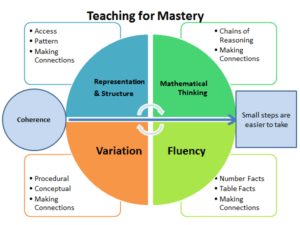
Through this Mastery approach, we aim for all pupils to develop a deep and secure understanding of mathematical concepts and procedures. In line with the aims of Development Matters and the National Curriculum, we seek to develop pupils’ fluency, reasoning and problem solving with the intention of enabling pupils to become fluent and life-long mathematicians, able to reason and apply their knowledge and skills across a range of known and unknown problems and contexts. Children are guided through each lesson at the same broad pace with differing levels of scaffolding and challenge.
Encouraging a positive attitude to maths is at the heart of all we do. We believe that all children can achieve and be successful in maths and promote a can-do attitude. ‘Marvellous Mistakes’ and ‘Magnificent Misconceptions’ are celebrated and explored at all levels and used to promote deeper understanding of mathematical concepts and procedures. We challenge the notion that some people ‘can’t do maths’ and instead use the language of ‘yet’.
How we Teach Maths
We follow the schemes from White Rose Maths which ensures children learn Maths in a progressive and coherent way through small steps of learning. This is supplemented by a range of high quality resources including Primary Stars, Master the Curriculum and I See Reasoning. Progression in maths is further supported by the NCETM Progression Maps. Each lesson begins with a KIRFs (Key Instant Recall Facts) session which is where children practise, rehearse and complete activities designed to improve and secure their recall of key facts.
The learning in the main lesson is organised into three parts: Do It, Secure It and Deepen It.
Do It involves the whole class working together and may include:
Secure It gives children the opportunity to work more independently to show security in the objectives of the lesson and may include:
Deepen It provides additional challenge in using and applying across various contexts which may include:

At Stourport Primary Academy, the aim of our Science Curriculum is to encourage our pupils to become knowledgeable and curious about the universe around them. In order to do this, they have the opportunity to develop the following scientific skills:
At Stourport Primary Academy, we also believe that it is important that children have opportunities to enrich their Science learning through links to other topics outside of those in the National Curriculum. This is achieved through opportunities such as Science Week investigations and One Big Idea, as well as through cross-curricular links.

At Stourport Primary Academy, we want our Art Curriculum to stimulate creativity and imagination which will help our learners to gain experiences in a variety of ways.
We believe that to become an artist and to develop their skills our pupils must have the opportunity:
To believe that they are an artist.

Technology is all around us and it is vital that at Stourport Primary Academy our Computing and ICT Curriculum teaches children to become masters of ICT, choosing when, and when not, to work with technology making safe and informed choices about how they approach and use ICT – every time. To do this, our pupils need to have the opportunity:
At Stourport Primary Academy, we follow the ‘Teach Computing’ curriculum which has been devised by experts from the National Centre for Computing Education in conjunction with the DfE.

At Stourport Primary Academy, from the children who are two years old in Nursery, to the children who are eleven years old in year 6, we develop the creative, technical and practical expertise so that each child can explore and participate successfully in an increasingly technological world.
All children will:
At Stourport Primary Academy we feel it is vital to nurture creativity and innovation through design, by exploring the designed and made world in which we all live.

At Stourport Primary Academy, we want our Geography curriculum to help our learners become curious about the wider world and their place in it. Geography will provoke and provide answers to questions about the natural and human aspects of the world. Children are encouraged to develop a greater understanding and knowledge of the world, as well as their place in it. The Geography curriculum enables children to develop knowledge and skills that are transferrable to other curriculum areas. Geography is an investigative subject, which develops an understanding of concepts, knowledge and skills. Our intent, when teaching Geography, is to promote the children’s interest and understanding of diverse places, people, resources and natural and human environments, together with a deep understanding of the Earth’s key physical and human processes.
At Stourport Primary Academy we want our History Curriculum to help our learners become curious and passionate about the wider world and their place in it. We believe that to develop the characteristics of an excellent historian our pupils have the opportunity:
At Stourport Primary Academy, children in Key Stage 2 learn to speak French, giving them a solid foundation and natural progression when they transition to High School. High quality languages education at Stourport Primary Academy fosters pupils’ exploration of the world in which they live through deepening their understanding of different languages and countries. Our aim is to broaden pupils’ horizons and encourage them to step beyond familiar cultural boundaries and develop new ways to discover and respect the world they live in.
To achieve this, our teaching develops pupils’ competency that is both broad and deep in the skills of listening, speaking, reading and writing based on a sound foundation of core grammar, vocabulary and phonics. We follow the Rachel Hawkes scheme of work for French, to ensure knowledge, vocabulary and language skills are acquired systematically and progressively; revisited, reinforced and embedded over time.

“Music is the universal language of mankind.” – Henry Wadsworth Longfellow
At Stourport Primary Academy our pupils will learn, through their enriched Music curriculum that is also embedded through all subjects, that music has a rare and unique ability, it is a universal language that brings people and places together. It is the soundtrack to our lives. We believe that to develop the characteristics of an excellent musician our pupils have the opportunity:
Most importantly, at the heart of our Music curriculum, we want our pupils to develop a lifelong love of music, including enjoying taking part in solo and group school and community performances, listening to recorded and live musical performances.
Click Here to read our Music Development Plan

At Stourport Primary Academy

The intention of RE at Stourport Primary Academy is to encourage all children to explore what different people believe and how this affects the way in which they choose to live their lives; while relating to one’s own ideas and ways of living.
Throughout their time at Stourport Primary Academy the children discover the knowledge, understanding and skills needed to deal with the questions raised by different religions and beliefs. To achieve this the children will: make sense of a variety of religious and non-religious beliefs, understand their impact and significance, whilst making connections. All encouraging an open and articulate understanding of society.
Stourport Primary Academy follows the Worcestershire Agreed Syllabus (2020 -2025) for Religious Education (RE) and uses resources from Jigsaw RE to scaffold and support the provision for pupils.
Parents do however retain the right to withdraw their children from RE. The parents will then be responsible for providing their own religious education. (School Standards and Framework Act 1998 S71 (3)).
Parents/Carers have a legal right to withdraw their child(ren) from all or some RE lessons. Should this be the case, please speak with the Head of School.

At Stourport Primary Academy we follow the scheme Jigsaw to ensure our PSHE and RSE curriculum provide our children with a broad, balanced and sequential curriculum that meets the needs of all pupils. We understand that Spiritual, Moral, Social and Cultural Education is promoted and that we have a duty of care to keep all of our pupils safe. Jigsaw holds the children at its heart, and its cohesive vision helps children understand and value how they fit into and contribute to the school and the outside world. We have taken our school values and connected these to the themes within the Jigsaw puzzle pieces, this is celebrated within all Jigsaw lessons. British values and SMSC are mapped out throughout Jigsaw lessons.

At Stourport Primary Academy we teach the New EYFS Framework through Development Matters. Our EYFS practitioners are dedicated to knowing each child individually and plan to get the best possible outcomes for every child. Topics and planning in our EYFS classrooms are based on the children’s interests. Through continuous provision the children have access to indoor and outdoor areas which are carefully created to pique the children’s curiosity and develop a lifelong love of learning. The progression maps below outline our expectations for each half term, and the key development opportunities as the years progress – the topics used to delivery these opportunities will change each year depending on the children’s interests, experiences and developmental needs.
In Key Stage One and Two we follow the National Curriculum. Themes in each half term have been chosen to engage the children and develop a love of learning, while building upon prior substantive and disciplinary knowledge, ensuring that pupils make progress across the school.


